The Great Divide
Saturday Storytime | Miss Primm
Until tonight, I haven’t worried about walking in a park at night for several centuries.
But he is here.
I sense it, hidden among the dark recesses of the park’s landscaping. Autumn leaves scuttle along the concrete path with a sound as sharp as broken glass. An owl hoots, then flaps away, but there are things in the dark even an owl fears—one of them being me.
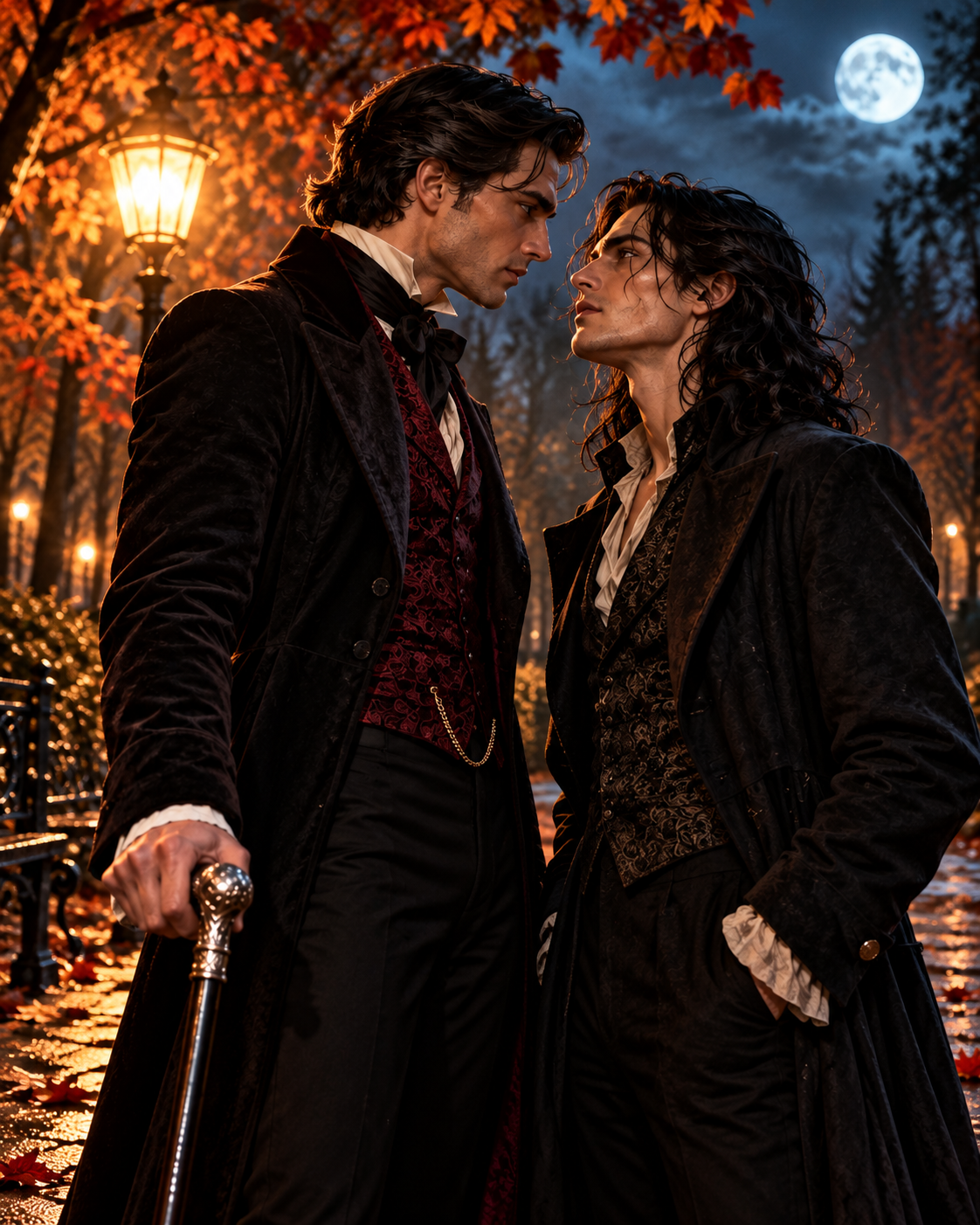
My cane, an affectation developed in the last century, clicks on the concrete. I could not give any clearer announcement that I am here.
My nose twitches. There are few things I can truly smell, but there are two. One is the scent of human blood. The other, the acidic tang of vampire blood.
One is for food.
The other—pleasure.
And I would know that scent anywhere.
“Claude.”
His name slipped from my lips before I could stop it.
Nothing moved among the trees. Even the wind seems to have fled the park.
“One hundred and sixty-three years,” I say. “And you still insist on making an entrance.”
“You’re one to talk, Arthur.”
His voice comes from somewhere behind me.
I don’t turn. I refused to give him the satisfaction.
“Still skulking about in the shadows, I see.”
“Still announcing your arrival like royalty.”
My fingers tightened around the silver head of my cane.
“Some of us have manners.”
“And some of us have learned a few in the intervening years.”
I smiled despite myself.
The bastard.
Claude emerged from the shadows, dressed in a dark coat that fell to his knees. His hair is shorter than I remember, but his face is unchanged. Of course, it would be. Time does not alter our kind, though it can do considerable damage to everything else.
He stopped several paces away.
“I still hate you,” he says.
I let the words hang, false and foul, twisting among the dark branches about us.
“No,” I say in a near whisper. “You don’t.”
“Of course I do. You know what you did.”
“I admit now it happened.”
“Good.”
“I don’t claim responsibility for missing the event.”
He snorts. “You never did. I got chained and buried, and you weren’t there.”
“I know.”
For a moment, neither of us spoke.
The last time I saw him was in 1863. The country was tearing itself apart, and we had done much the same to our friendship.
I had business interests in Georgia, brokering cotton sales for plantation owners who considered preserving their way of life a sacred duty. Claude considered that way of life an abomination.
We argued about slavery, secession, and the Union. I spoke of commerce, contracts, and economic ruin. Claude spoke of human beings.
Neither of us would yield.
He called me a profiteer. I called him a sentimental fool.
I have had considerable time to reconsider the wisdom of that remark.
“I couldn’t have known,” I say.
“They caught me while I waited for you.”
His voice is quiet now, and somehow that is worse than his anger.
I know what burial means to our kind. We do not suffocate. We do not starve to death. We remain conscious, trapped in the dark, with nothing but our thoughts and the slow passage of years.
Claude had been fortunate. Grave robbers disturbed his grave seventeen years later.
I have never had the chance to ask what those years were like.
Perhaps I have been afraid of the answer.
“The country was at war, Claude. I never got your letter telling me—well, you know what you said.”
Claude scoffed. “Excuses.”
“But I did see the letter.”
“Aha!”
“Last week. It was under glass in the Smithsonian.
“What?”
“The legend card said it had been found behind a wooden sorting rack in 1920. Apparently, it had slipped there during the war and remained undiscovered for nearly sixty years. It was shipped to the museum and kept in the archives until someone brought it out for a display on Civil War love letters.”
Claude hissed, rather like an angry cat.
I find the sound strangely comforting. Some things, at least, have not changed.
“I was moved. Enough to seek you tonight,” I say. “You know what tonight is.”
His eyes narrow.
Of course he knows.
It is the anniversary of the evening we first met here, when it was a road running into Boston, long before there was a United States, let alone a war between its states. For more years than I care to count, we marked the occasion together.
Until we didn’t.
“Are you telling me,” Claude says slowly, “that I suffered because—his throat choked, it languished in the dead letter office?”
My lips curl upward.
“Irony, is it not? A letter sent from one undead to another.”
His expression suggested that he is considering burying me himself.
I tapped my cane against the path.
“The museum called it a remarkable example of nineteenth-century romantic correspondence. The curator was particularly impressed by your handwriting.”
“Arthur.”
“And your eloquence. I had quite forgotten your fondness for poetry.”
“Arthur.”
“Though I question whether displaying private correspondence for public entertainment is entirely ethical.”
“Arthur!”
I fall silent.
He took a step toward me.
“Do you have any idea what it was like? Waiting for you? Believing you had chosen your precious cotton merchants over me? And then, when they caught me, I thought perhaps you had betrayed me yourself?
That accusation strikes harder than I expected.
“I never betrayed you.”
“You abandoned me.”
“I didn’t know where you were.”
“You didn’t look!”
In truth, I searched for months, following rumors through war-devastated towns. But I never found him, and eventually, I convinced myself of something I shouldn’t have.
“I thought you had left me,” I say.
Claude stared, his preternatural eyes gleaming in the moonlight.
“Left you?”
“Yes.”
He looked away, toward the trees. Somewhere beyond the park, traffic moves through the city, carrying people whose entire lives will pass in less time than Claude and I have spent refusing to speak.
“I waited for you,” he says again.
“I know.”
“No. You don’t.”
Perhaps he’s right.
I have spent 163 years misunderstanding what had happened. Now I know what he wrote, what he risked, and what he believed when I failed to appear.
I have also spent the past week remembering every word of that letter.
Claude turns back to me.
“Am I supposed to forgive you now?” he asks bitterly.
I look at the man who was once my closest companion, my fiercest adversary, and the one creature on this earth whose absence has made eternity seem unbearably long.
“You never need to forgive me, because I confess, I love you, too.”