I’ve ghostwritten fiction for over twelve years. I’m also a developmental editor and the author of Hanging by a Thread, the first book in my MM neo-noir romantic suspense series, The Justix Files.
So when I discovered Reader’s Verdict, an AI beta-reading service that assembles a jury of simulated readers to evaluate manuscripts, I was curious.
The premise is intriguing. Instead of one AI assessment, you get several readers with different personalities, preferences, and literary expectations. They evaluate your manuscript, deliberate, and produce a consensus verdict.
I submitted the first two chapters of Hanging by a Thread, deliberately leaving out the optional genre information. I wanted to see whether the AI readers could identify what kind of story they were reading.
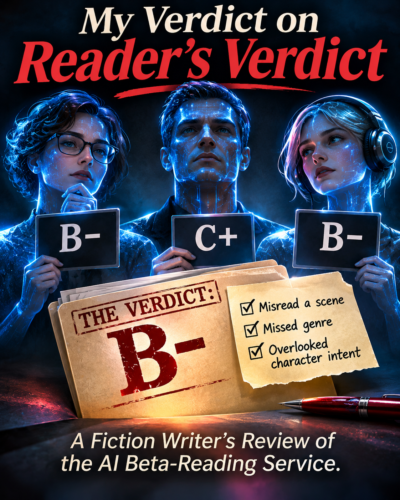
Three readers delivered their verdict: B-, C+, and B-. The consensus was B-.
I wasn’t particularly concerned about the grades. The reviews I’ve received so far on Goodreads give me 4.82 stars, so I didn’t miss the storytelling mark.
What concerned me was the reasoning.
When Humor Becomes a Crime In a Police Procedural
In Chapter Two, rock star Rik Drake discovers a dead man suspended above his swimming pool, wearing a white robe and red ballet slippers. Worse, Rik recognizes the silk bondage rope around the victim’s neck.
It’s a grotesque scene.
Rik is terrified. He’s shaking, nauseated, suffering a terrible headache, and confronting a gap in his memory that raises frightening questions about his sobriety.
But Rik also makes jokes.
The AI readers repeatedly criticized his humor for undermining the horror of the scene. They wanted more dread, more emotional weight, and fewer wisecracks.
Here’s the problem.
Rik’s sarcasm is how he handles fear.
He’s a wealthy, famous man accustomed to controlling his environment. When that control disappears, he falls back on the one weapon he can still wield: his mouth.
The humor isn’t there to reassure readers that everything is fine. It’s there because Rik most certainly isn’t fine.
Take this line:
Rik: Short and long-term memory loss is firmly in place. Excellent. Just what a recovering addict needs.
Grotesque juxtaposition of horror and sardonic humor is a recognizable characteristic of noir.
The AI readers identified the emotional contrast but treated it as a defect rather than asking whether it was intentional.
That’s a significant distinction.
When a character uses humor to conceal terror, removing the humor may also mean removing the characterization.
Three Readers Agree. So What?
Reader’s Verdict emphasizes the value of multiple AI perspectives and deliberation. The idea is that when independent readers identify the same problem, the author should pay attention.
That sounds reasonable.
Until all three readers misunderstand the same thing.
In Chapter Two, the reviewers criticized what they believed was a failure to secure the crime scene. They thought Rik had allowed visitors into the property after police arrived.
But that isn’t what happened.
Amanda arrived before the police secured the scene. Officer Harris subsequently instructed his partner, Jim, to secure the entrance and establish a scene log.
Later, attorney Chase Ross appeared unexpectedly beside Rik.
Because the chapter is written in Rik’s first-person point of view, Rik doesn’t see Chase approach. That doesn’t mean Chase bypassed police security.
In fact, Harris later asks Jim whether the attorney’s arrival was logged. Jim confirms that it was.
The procedural safeguard the reviewers claimed was missing was explicitly present in the manuscript.
Yet their agreement gave the criticism an appearance of authority.
Three AI readers making the same mistake doesn’t make the mistake true.
And this raises a larger question about AI deliberation. Are the reviewers genuinely testing each other’s conclusions against the text, or are they reinforcing shared assumptions?
Consensus is useful only when the underlying reasoning is sound.
Reader’s Verdict Isn’t The Only AI Program With That Problem
When I edited Hanging by a Thread using AutoCrit’s Alpha and Beta Reads, AutoCrit AI readers complained that Rik’s interiority slowed the pacing of the story.
PWA had a similar problem. It flagged Rik’s emotional collapse as sudden and “unearned.” But I had left subtle clues throughout—moments of sarcasm masking relapse cravings, shifts in tone, and relational disconnects that would stand out clearly to anyone familiar with addiction behavior. PWA doesn’t catch that. It doesn’t know that not attending therapy is a red flag. It doesn’t know that silence can be a scream.
When you’re threading emotional damage into a character’s arc, working dual POV to deliver misaligned realities, or weaving psychological tension through omission—the AI readers might not see it.
That’s not a flaw of the software. That’s the limit of current AI pattern logic. It’s not broken. Pattern matching in language doesn’t always track how a story builds within an emotional arc.
A Reader’s Reaction Isn’t an Editorial Diagnosis
I want to make a point clear. I’m not arguing that beta readers must interpret my fiction exactly as I intend.
Quite the opposite.
One reason writers need beta readers is to discover the difference between what they believe they’ve written and what readers actually experience.
But there are three distinct levels of feedback.
Reader reaction: “I didn’t feel frightened for Rik.”
That’s valuable information.
Reader interpretation: “Rik isn’t frightened because he makes jokes.”
That’s a hypothesis. It needs to be tested against the manuscript.
Editorial prescription: “Remove the jokes to increase the suspense.”
That’s a proposed solution, and it may damage the very characterization the author is trying to establish.
These three things aren’t interchangeable.
A reader can accurately report an emotional response while incorrectly identifying what caused it.
And an editor who accepts that diagnosis without examining the narrative may make matters worse.
The Cost of Editorial Advice
I’ll admit something else.
I’m still not entirely comfortable with the pacing of Chapter One of Hanging by a Thread.
It sometimes feels like driving thirty miles per hour in a fifty-mile-per-hour zone.
A conventional murder mystery might begin at the crime scene. Mine doesn’t.
Instead, Chapter One introduces rookie LAPD detective Jessick Justix, his professional ambitions, his father’s disgraced reputation, and the institutional pressures shaping his behavior.
Why?
Because The Justix Files isn’t primarily about solving a murder. It’s about the slow psychological unraveling of two men who ultimately become willing to protect each other at considerable personal cost.
The murder investigation brings them together. Their relationship is the story.
Readers need to understand what Jessick stands to lose before those losses become possible.
Could I accelerate the opening? Certainly.
But what would I sacrifice?
That’s the question editorial recommendations too often overlook.
Every addition, deletion, and rearrangement changes the balance among pacing, characterization, suspense, and emotional investment.
Editorial advice is incomplete until it accounts for the cost of implementing it.
I’m not claiming my opening chapters are perfect. I’m saying they’re the closest I could get to constructing a coherent narrative while balancing competing demands.
And since the book is published, I’m not rewriting it to satisfy three AI reviewers.
A Story Must Resonate First
A technically efficient opening isn’t necessarily emotionally engaging.
You can introduce a murder on page one, accelerate through the investigation, and deliver perfectly timed revelations. But if readers don’t care about the characters, why should they care who committed the crime?
Conversely, a slower opening can establish the emotional connection that carries readers through an entire novel.
That’s the distinction between narrative velocity and reader engagement.
And it’s particularly important in romance, where readers aren’t simply following events. They’re investing in relationships.
In The Justix Files, Rik and Jessick make mistakes, hurt each other, and sometimes make terrible decisions in the name of protecting one another. Those choices matter because the reader understands the psychological foundations established early in the story.
The objective isn’t to create flawless characters. It’s to create characters whose actions make emotional sense.
Is Reader’s Verdict Worth the Money?
Reader’s Verdict offers an interesting service. Multiple simulated reader perspectives can expose ambiguities, reveal unexpected reactions, and give authors questions worth investigating.
But its central selling point—deliberation leading to consensus—deserves scrutiny.
For my manuscript, a full review would cost approximately $40. That’s somewhat less than the comparable ProWritingAid assessment I priced, but AutoCrit already provides me with genre-oriented analysis at no additional cost because I have a lifetime subscription.
The issue isn’t simply price.
It’s whether the service provides insight I can trust.
For an experienced writer, questionable advice can be challenged against the manuscript and the author’s intentions. A less experienced writer may accept a confident jury verdict as proof that the story needs fixing.
And that could encourage revisions that make a manuscript more conventional without making it more compelling.
My experiment involved only two chapters and three AI readers. That’s not enough to condemn the entire service. But it’s enough to question how much authority its verdicts deserve.
My Verdict on Readers’ Verdict
Three AI beta readers evaluated my manuscript and agreed that it needed improvement.
They may be right about some things.
But they also mistook a character’s psychological defense for insufficient emotion, struggled with neo-noir conventions, and criticized a procedural omission that wasn’t actually missing.
The problem wasn’t that they disagreed with my artistic choices.
The problem was that they sometimes treated their interpretations as facts and their expectations as rules.
A useful beta reader doesn’t have to love your book. A useful critic doesn’t have to agree with the author.
But good criticism should help writers understand whether their story is reaching readers, not simply tell them how to write a different story.
And that, I think, is the verdict that matters.