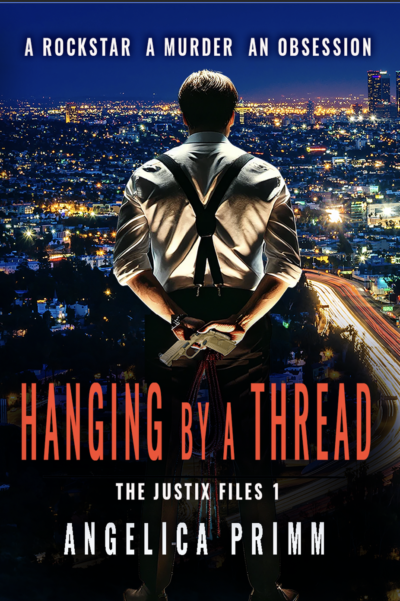
#thriller #crimereaders #sundaysnippet
(Miss Primm Blog)
Across more than a hundred books, both for my ghostwriting clients and my personal writing, I haven’t rewritten a chapter as many times as chapter one of Hanging By A Thread. This is odd, as the first chapters are my jam. I know the drill: a hooky first line, the whole life as it is a story, and a last line that pulls you into the next chapter. There is an advantage to being a ghostwriter, as by the time you get to your work, you know exactly what you should put where.
Or so I thought.
Not that the first attempts were bad. But I was writing a new genre, and different genres have different meat you need to chew to get the reader interested. I knew the rest of the book was solid, and that meant editing was minimal—mostly trimming and rewording. Structure is one of my strengths, so I wasn’t worried about a saggy middle or an end that failed to deliver. But, no lie, I sweated that first chapter, knowing that my brand new series lived and died on the strength of it.
And now with Book 2, Loose Ends, due to drop October 2, I’ve decided to release Hanging By A Thread for free for two days, probably on Wednesday.
But to get you started, here is:
Chapter One of Hanging By A Thread:
Jessick
Traffic ground to a halt on LA’s 405, threatening to steal the gold shield clipped to my belt. I’m late for my new assignment, rookie detective, West Hollywood Division.
“Damn,” I muttered.
A video stream alert popped up on my phone, perched on the dash, hosted by LA’s trashiest crime app, WeHo Beat. Two patrol cars. An ambulance. Flashing lights. High-end iron gates. The breathless voiceover hit a familiar note: Death in Celebrity Home in the Birds.
Hell, on my first day, a high-profile death hit my jurisdiction, and I’m not at the station.
I glanced at the dashboard clock. Dad would’ve been rolling by now, badge out. He’d dragged me to enough crime scenes that I knew the cardinal rule. The first detective on the scene owns the case. And here I was, stuck in traffic.
But things had changed since Justice Justix carried a badge. And it was unlikely I’d get assigned a high-profile case on my first day. Better I didn’t screw up and met my captain on time.
Because family history tells me the capacity for screw-ups is written in my DNA. Plus, LA is my hometown. The fever that burns through it runs through me.
With my commute edging past an hour and a half and the clock closing in on eight a.m., my stomach shifted from a tight knot to an acidic roil. Not good. If I got called out to a scene after working hours, the response time would be too slow. And as a rookie detective, I knew I’d catch the crimes that punctuated L.A. nights and holidays.
Finally, I reached Route 2, where every block had a stoplight, and the stop-and-traffic stuttered forward. I checked the dashboard clock again. It would be a minor miracle to make the captain’s intro meeting on time.
“Where?”
I scanned the street and then found a building set back behind a continuous line of two-story office complexes. A small sign marked it West Hollywood Station, LAPD.
The station was made of glass and metal, two stories tall, like every other commercial building in the area, all packed in between three earthquake fault lines: north, east, and west. I turned into the driveway and cruised to the side lot while my eyes scanned for an open spot.
I rolled past a line of black-and-white patrol units and slid into a space labeled “employee parking.” As I killed the ignition, a uniformed officer appeared at my driver’s side window. I cracked it open.
“You can’t park here, son.”
I moved my hand toward my jacket, and he tensed, his hand drifting to his weapon. I froze, hands open and visible. His expression told me he was one of those cops who took the tin badge as a license to act officiously.
“I’m reaching to show you my ID, officer,” I said calmly. “Is that okay?”
“Just move the car,” he barked.
I glanced at the dashboard clock again. Five minutes to eight.
“Would love to,” I said coolly. “But then I’d be late for my appointment with my new captain. I’m Detective Jessick Justix. Today’s my first day.”
He grunted and didn’t relax an inch.
“Show me your ID.”
I sighed inwardly as I pulled aside my suit jacket to display my freshly minted badge on my belt, with the word “detective” emblazoned on top, then handed him my wallet ID. He stared as if the name meant something.
“Justix,” he muttered, chewing on the name. Why’s that familiar?”
Not today, I thought. You don’t get my father’s story.
“Excuse me, Officer. I need to go.”
“Of course, Detective.” He barely moved aside, his voice sharp-edged, as if assessing me when I exited my car.
For my first day, I wore what I saw my father put on each day, an impeccably cut suit that suggested authority without flash, and the final touch, black Christian Louboutin Urbino shoes.“You can’t command respect in this town,” Dad once said, “unless you speak its language. And clothes, son, are the first words out of Hollywood’s mouth.”
My dad’s closet was filled with suits such as these, and they still hung there. I had been too busy with LAPD’s detective school to do anything about them after he passed.
The beat cop stood aside as I walked past him into the station. The LAPD seal took center stage on the right-hand wall, flanked by the words: West Hollywood Division. Framed photos of the command staff hung in tight, symmetrical ranks beside it.
A row of empty chairs lined a small waiting area. Beyond that, a long desk divided the public lobby from the restricted work area. To the left, a single shut door was the lone access to the station proper.
The interior of the station exuded an unmistakable industrial “fresh” scent, causing my nose to twitch. West Hollywood Station had just emerged from the LAPD’s latest jurisdictional reorganization. For its shiny new division, the brass carved out neighborhoods from the edges of Beverly Hills and took a bite of the old West Division up to Route 405.
At the desk sat a uniformed female officer, her hair scraped back into a no-nonsense bun, her hands flying over a computer keyboard.
I walked up, “Detective Justix. Here to see Captain Abbott.”
She barely flicked a glance at me, then clacked a few more keys.
“I’ll let the captain know you’re here,” she said, her eyes darting to the first row of chairs with the clear, unspoken suggestion to sit and wait.
Yeah, not happening.
I walked past the chairs to lean against the far wall, arms crossed over my chest, projecting an air of relaxed patience. Inside, my stomach ran riot.

He held out his hand. “Detective Russ Teller,” he said. “You must be Jessick Justix.”
I took his hand briefly. His firm but perfunctory grip revealed no warmth.
Not unexpected.
“I’m your training officer,” he said flatly.
“Good to meet you,” I said.
“Captain Abbott asked me to bring you back and help settle you in. He’ll catch up later. He’s tied up on a call with a Deputy Chief. Follow me.” He jerked his chin toward a side door.
“We have an elevator that goes to the second floor, but we use it for handicapped access.” He pushed open a heavy stairwell door. “Better to use the stairs. Especially when ‘the Big One’ finally hits.”
“We’re all just waiting,” I said dryly.
“Yeah,” he grunted.
Teller moved with clipped precision. Practical. Black breakaway tie, scuffed shoes, and a familiar scent: lemon, juniper, and bergamot. Old school.
“Bowling Green?” I asked.
He grunted. “Excuse me?”
“My dad wore it. Not many do.”
“Did your dad teach you how to be a detective, too?”
I smiled without showing teeth. “I learned a few things on my own.”
Like how to survive cops like you.
“Good.”
Upstairs, the squad room had eight desks, maybe half in use. A woman, perhaps in her late forties, sat like a commanding general at the L-shaped admin desk to the left of the door. Her computer was surrounded by a chaotic shrine of miniature cats made of metal, ceramic, and polyresin.
She smiled at me like I hadn’t just walked into a minefield. Her desk nameplate read “Angela Harrow.”
“Teller,” she called. “You caught one. Nice way to break in the new guy.” She handed Teller a slip of paper.
“This is Angela,” Teller said over his shoulder. “The squad’s secretary.”
“I prefer the term Administrative Support,” she said. “I’m not anyone’s secretary.”
“And I’m Brad Pitt. Angela, meet Detective Justix.”
“Welcome, detective,” Angela said, her smile still warm. “Don’t let this old grump give you a hard time.”
“I am not a grump.”
“Says you,” Angela shot back. ”Anyway, and it kills me to say it, but you couldn’t have pulled a better Training Officer.”
“Gee, thanks,” grumbled Teller.
“And he has a million stories about being on the job. Some of them are amusing.”
“I know a story about a mouthy secretary who disappeared, never to be seen again.
“It’s not as good as the one where someone tried to use pizza as a murder weapon. Tell him that story, Teller.”
“We don’t have time for stories. We need to get this kid up to speed.”
Teller read the slip Angela handed him, then looked at me.
“What is it?” I said.
“Suicide. Rope hanging at the house of some clown named Rik Drake.”
A needle-sharp twinge struck my chest. Not him. Can’t be.
“Now, Teller,” said Angela in a teasing voice, “don’t act like you don’t know an international rock star’s name.”
“I do, and now we get to deal with his circus.”
My jaw clenched. “Did he?”
“Naw. Someone else.”
Teller’s eyebrows scrunched, and his face hardened as we walked from the station and climbed into an immaculately kept department-issued Ford. As we climbed the Hollywood Hills, Teller worked his mouth as if gnawing a toothpick, and the tension in the car could have shattered glass. But before we hit the Birds, that special residential section where billionaires’ landscaping cosplayed middle-class, he turned toward me and huffed.
“Your father used to bring you out on cases when you were a kid.”
I stiffened. As a single dad with no help and weird work hours, he had no choice.
“Yeah.”
“We don’t put up with that cowboy shit now.”
I glanced out the window, sighed, made a decision, and turned back to Teller.
“Okay,” I said. “Let’s just get it out. You don’t want the son of a dirty cop on your squad. I get it. My father was Justice Justix, one-time cop superhero, until he wrecked the department’s public trust, maybe your personal belief system, and now you’ve got me, and you hate it.”
Teller stared straight ahead and tapped his fingers on the steering wheel. “So, you’ve heard it before.”
“Damn straight.”
“Then you know. One screw-up, and you’re done.”
“Yes.”
“While I’m your TO, if you make me look bad, I’ll run you off myself.”
“Is that a threat or a promise?”
“Both. I’m a man of my word.”
“Good to know, sir.”
“I’m glad we understand each other.”
I turned my gaze to the window. Low recruitment stats made getting inside LAPD’s blue wall easier, but it didn’t earn me a pass for my father’s sins. I couldn’t afford mistakes as a beat cop. I didn’t intend to commit them now.
As we rounded a steep corner, flashing red and blue lights pooled before a black metal gate and thick hedges. A coroner’s van was parked behind an ambulance, while a uniformed officer stood guard behind crime scene tape that formed the “do not cross” zone for the paparazzi lurking a few feet away.
“This is the place,” Teller said. He threw the Ford into park and turned to me. “Okay. You’re lead on this.”
“Excuse me?”
“You heard me. You can conduct a suicide investigation, can’t you?”
“We assume a crime occurred and rule it out before calling it a suicide.”
“That’s what they taught you. Look, the M.E. is here, and patrol already secured it. We’ll do the song and dance and process it for a crime. But I’m telling you, this is a rubber stamp. Don’t waste my time.”
I bit back the retort burning on my tongue.
“Yes, sir.”
“Let’s go, then.”